 Bulgarian
 English


Approximate reading time: 14m 3s
By 2025, millennials will make up 43.1% of the global workforce, and by 2030 - 43.3%. This slight increase is due to the fact that they will be overtaken by Generation Z, which in 2020 was only 6.4%. Companies like Ernst & Young and Accenture report that millennials already account for more than 2/3 of their employees.
According to a Pew Research Center study, by 2030. "all members of the baby boomer generation" will reach retirement age of 65. As a result, by 2030 millennials will make up 43.3% of the global workforce, followed by Generation Z - 34.7%, and Generation X - 28.4%.
Of course, when building a corporate university, we must take all generations into account, but above all we should focus on millennials and the arrival of Generation Z.

Who are millennials and Generation Z?
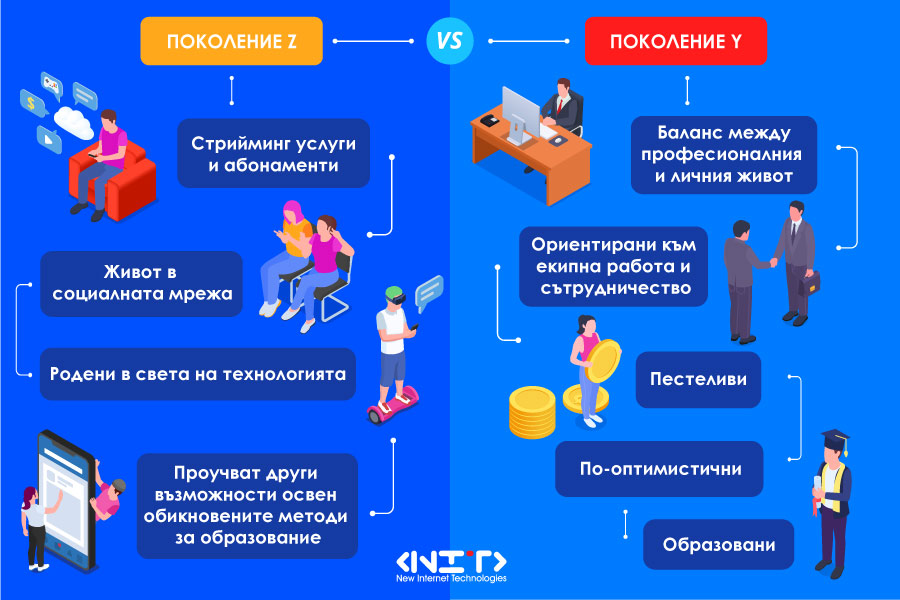
Millennials are people born between 1981 and 1996. Today they are between 26 and 40 years old. This is the largest percentage of working people. They are often called Generation Y. According to Wiki, the term comes from the first members of the generation who finished school in 2000, i.e. the millennium. Millennials are one of the first generations to grow up as "digital natives", with the internet, social networks, search engines, and accessible fast internet. Millennials are one of the most stressed generations. After the 2008 financial crisis, they had to find work somehow. They were under pressure from social networks. Growing consumption, climate change, and other factors also left their mark. Zoomers (Generation Z) were born between 1997 and 2009. Today they are between 13 and 25 years old. So some of them are still studying, while others are working. Generation Z is followed by Generation Alpha - those born after 2010. They are children now. But in ten years they will be extremely active in the workplace.
The virtues of millennials
- 87% of millennials believe that opportunities for professional or career development are important to them.
- There are more millennials with higher education (and even more than one degree) than any other generational group.
- Millennials are more open to travel and internships, which gives them a fresh and holistic perspective.
- Unlike previous generations, millennials handle technology with ease. They are not afraid of technological progress and learn easily.
- Millennials are believed to be more socially conscious and are motivated to work in companies, especially startups, that strive to benefit the world rather than make a profit.
- Millennials are programmed to prioritize their work and consider it an important factor in their lives (if not the most important one).
- At the same time, millennials burn out at work more often than any other generation.
What drives millennial motivation?
The year 2022 is interesting because you can see representatives of 4 generations in one team. The youngest member of the Baby Boomers is 58 years old today, the youngest member of Generation X is 42 years old, the millennial is 26 years old, and the oldest Zoomer is 25 years old.
Trying to determine what motivates people from different generations can be difficult. What we know is this:
1. The motivation of baby boomers lies in a high salary, bonuses, engagement, status among their peers, and a passion for sharing knowledge (in the spirit of the principle: "I know everything better than you"). This is the generation of "face-to-face meetings", almost untouched by the internet and even mobile phones.
2. Generation X is among the first to have mobile phones and the internet. If baby boomers are devoted to the company, Generation X is among the first to focus on opportunities, using the workplace as a springboard for skill and career development. They are also the first to face the challenge of "finding a balance between professional and personal life".
3. Millennials are motivated by retirement savings, as shown by a Capital Group study.
In addition:
- There are fewer gender pay gaps and fewer differences in appointments to leadership positions;
- Social work for disadvantaged groups;
- More opportunities for minorities;
- Flexible working hours: 70% of millennials want to set their own working hours and work remotely or from home;
- The Simon Sinek interview about millennials (you can read the interview below) states that this is a generation with low self-esteem and high levels of depression, and it is important for corporations to support them in dealing with these problems, help them develop confidence, and improve their relationship-building skills;
- According to a Cone Communications study, 62% of millennials are willing to accept a lower salary if they work for a company with high corporate social responsibility.
4. According to Powwownowz, Generation Z is motivated by rapid career development, recognition, and constant change. Let us not forget that this is the first generation that had a tablet and a phone before it could walk.
Millennials and technology
Even as children, millennials are on familiar terms with computers, software graphical interfaces, and internet applications. With these skills, they easily understand how to use visual languages. They quickly and easily master new programs, technological devices, operating systems, and perform computer tasks faster than older generations. Millennials participate in life on the internet and social networks with ease and pleasure.
How do we train millennials?
1. Introduce digitalization
Millennials grew up with the latest digital tools. Traditional lectures are too boring for them, so education must be digitalized. The ideal solution would be to create a corporate university with a remote learning system: LMS.
2. Encourage activity and engagement
Millennials prefer different active learning methods. When they are not interested, their attention quickly shifts to something else. So use more multimedia content and less dry text. Encourage employees to create their own courses when they have something to say. Millennials are highly creative people and will strive to do everything they can while they are motivated.
3. Create an informal learning environment
Millennials prefer a less formal learning environment where they can interact informally with trainers, mentors (lecturers), or with each other. Of course, the lecturer should not become their best friend; they just need to be seen as "someone on their side".
They also prefer to learn when it is convenient for them, not at a fixed time. Therefore, make sure to have mobile learning, which will be accessible anywhere and anytime.
4. Provide practical and relevant training
Millennials are the first generation used to "Googling" everything they need. For them, information is not always valuable on its own. The practical application of the information received is more valuable. That is why in every class or course it is extremely important not only to provide knowledge, but also to explain how to apply it in work or in personal life.
5. Offer development and growth
Take part in the personal and professional development of your employees. This will be of great benefit to the company. Well, at the very least because this way you will be able to reduce staff turnover. After all, the company spends an average of 1.5-2 salaries on recruitment.
According to a Harvard Business Review study, 33% of new employees look for alternative work within the first 6 months, and 22% within the first 45 days. But millennials tend to stay longer with the company that develops them.
6. Make training personal by introducing personalization
Create personalized learning experiences for your employees. For example, it is possible to create separate video messages for employees in Berlin, Paris, and New York that will be relevant to them. In the corporate university, you do not even need to create different courses or lessons. You will be able to offer dynamic content, which will allow you to personalize your employees' learning based on preset or user-created goals.
7. Use workforce branding
Create a branded corporate academy, but not just one - several! This way you can personalize the audience's learning experience and make the brand even more recognizable and respected. For example, you can create a corporate university and a separate portal from it where courses can be created by anyone who wants to. As a result, you will encourage company innovation. All you need is your domain, logo, favicon, brand colors, and even captions with your brand. For example, training in the corporate university can be more formal, while courses in the employee portal can be less formal/informal.
In conclusion
With the help of LMS from NIT you will be able to create the ideal learning environment for your employees. For them, information is not always valuable on its own. The practical application of the information received is more valuable.
***
Interview with Simon Sinek "Millennials in the Workplace" - https://www.youtube.com/watch?v=5MC2X-LRbkE
Obviously, millennials as a group of people born approximately from 1984 onward are difficult to manage. They are accused of being demanding, narcissistic, self-centered, unfocused, and lazy - but the demands are the biggest.
Because they confuse management so much, leaders will say "what do you want?" And millennials will say: "We want to work in a place with purpose, we want to make an impact, we want free food and beanbag chairs". And yet, when given all those things, they are still not happy. And that is because there is something missing, some piece.
In fact, it can be divided into 4 parts. 1 Upbringing. 2 Technology. 3 Impatience. 4 Environment.
The generation called millennials, too many of them grew up under the influence of "failed parenting strategies". They were told they were special all the time, they were told they could have anything they wanted in life simply because they wanted it. Some of them got into great classes not because they earned it, but because their parents complained. Some of them got A's not because they earned them, but because teachers did not want to deal with the parents. Some children got a participation medal, got a medal for finishing last. Science is clear that this devalues the medal and the reward for those who actually work hard, and it actually makes the person who came in last feel uncomfortable because they know they did not earn it, so it actually makes them feel worse.
You take this group of people, they graduate, get jobs, and enter the real world and at some point they realize they are not special, that their mother cannot promote them, that you do not get anything for being last, and by the way you cannot get it just because you want it. At some point their whole self-image is shattered. So we have a whole generation growing up with lower self-esteem than previous generations.
The other problem is that we are growing up in a Facebook/Instagram world, in other words, we know how to put filters on things. We are good at showing people that life is amazing, even though I am depressed...
Everyone sounds cool and everyone sounds like they have figured everything out, but in reality there are very few "cool" people and most people have not figured everything out. So when older people say "well, what do we do?", they sound like "here is what you should do!" - but in fact they have no idea.
So you have an entire generation growing up with lower self-esteem than previous generations - through no fault of their own, they were dealt a bad hand. Now let us add technology. We know that engagement with social media and our mobile phones releases a chemical called dopamine. That is why when you receive a message - it feels good. In a 2012 study, Harvard scientists reported that when we talk about ourselves through social media, a pleasure center in the brain is activated that is usually associated with food, money, and sex. That is why we count likes, that is why we go back ten times to see if the interaction is growing, and if our Instagram slows down, we wonder if we did something wrong or if people no longer like us. The trauma of young children being unfriended is too much to deal with. We know that when we get attention, we feel good, we get a dose of dopamine that works well for us, and so we keep coming back to it. Dopamine is the same chemical that makes us feel good when we smoke, when we drink, and when we gamble. In other words, it is highly, highly addictive...
We have age limits for smoking, drinking, and gambling, but we do not have age limits for social media and mobile phones. Which is equivalent to opening the liquor cabinet and telling our teenagers: "hey, by the way, if this adolescence thing is getting you down - help yourself".
Now an entire generation has access to an addictive, numbing chemical called dopamine through mobile phones and social media while going through the intense stress of adolescence.
Why is this important? Almost every alcoholic discovered alcohol when they were a teenager. When we are very, very young, the only approval we need is our parents', and when we go through adolescence, we make that transition where we now need the approval of our peers. This is very unpleasant for our parents, but very important for the teenager. It allows us to become part of a wider circle of people outside our immediate family. This is a highly, highly stressful and anxious period of our lives, and we are expected to learn to rely on our friends.
Some people, quite by accident, discover alcohol, the numbing effect of dopamine, to help them cope with the stress and anxiety of adolescence. Unfortunately, this gets wired into their brains, and for the rest of their lives, when they experience significant stress, they will not turn to a person, but to the bottle. Social stress, financial stress, career stress - these are almost all the main reasons why an alcoholic drinks. But now, because we allow unlimited access to these devices and media, in principle this becomes hardwired and what we see is that when they grow up, too many children do not know how to create deep, meaningful relationships. "Their words, not mine."
They will admit that many of their relationships are superficial, they will admit that they do not rely on their friends, they do not rely on their friends. They have fun with their friends, but they also know that their friends will cancel them when something better comes along. There are no deep meaningful relationships because they have never practiced the skills for that and, even worse, they have no coping mechanisms for stress. So when significant stress starts appearing in their lives, they do not turn to a person, but to a device, to social networks, to those things that offer temporary relief.
We know, science is clear, we know that people who spend more time on Facebook suffer from higher levels of depression than people who spend less time on Facebook.
These things are balanced, they are not bad. Alcohol is not bad, too much alcohol is bad. Gambling is fun, but too much gambling is dangerous. There is nothing wrong with social media and mobile phones, the problem is imbalance.
If you are sitting at dinner with your friends and texting someone who is not there - that is a problem. That is addiction. If you are sitting in a meeting with people you are supposed to listen to and talk to, and you put your phone on the table, that sends a subconscious message to the room: "You are simply not that important." The fact that you cannot put the phone away is because you are addicted.
If you wake up and check your phone before saying good morning to your girlfriend, boyfriend, or spouse, you have an addiction. And like all addictions, over time it will destroy relationships, cost time, money, and worsen your life.
So we have a generation growing up with lower self-esteem, with no coping mechanisms for stress, and now you add impatience. They have grown up in a world of instant gratification. You want to buy something, you go on Amazon and it arrives the next day. You want to watch a movie, you go into the system and watch a movie. You do not check movie times. You want to watch a TV show, just watch it. You do not even have to wait a week by week. A lot of people skip seasons just so they can binge at the end of the season...
Instant gratification. Want to go on a date? You do not even have to learn how to be socially awkward on a first date. You do not have to learn how to practice that skill. You do not have to be the awkward person who says "yes" when they mean "no", and "no" when they mean "yes". Swipe right - boom - done! You do not even have to learn the coping mechanism for social problems.
Everything you want can be obtained instantly. Everything you want, instant gratification, except for job satisfaction and the strength of relationships - there is no shortcut for that. They are slow, winding, awkward, messy processes.
And so, millennials are wonderful, idealistic, hardworking smart kids who have just graduated and are in entry-level jobs, and when asked "How is it going?", they say "I think I am going to quit". And we ask ourselves, "Why?" and they say, "I am not making an impact." To which we reply - "you have only been there for eight months..."
It is as if they are standing at the foot of the mountain and have an abstract concept called impact that they want to have on the world, and that is the summit. What they do not see is the mountain. I do not care whether you climb the mountain quickly or slowly, but there is still a mountain. So what this young generation needs to learn is patience. That some things that really, really matter, such as love or job satisfaction, joy, love of life, self-confidence, skillset, all of those things, take time. Sometimes you can speed some of them up, but the overall journey is painful, long, and hard, and if you do not ask for help and learn these skills, you will fall off the mountain. Or the worst-case scenario - we are seeing an increase in suicides in this generation, an increase in drug overdose deaths, more and more children dropping out of school or taking leave due to depression. Unheard of. It is really bad.
At best, we will have an entire society growing up, going through life, and never finding joy. They will never find deep, deep fulfillment in work or in life, they will just go through life and things will be just "fine". "How is work going?" "Fine, same as yesterday..." "How is your relationship?" "It is okay..."
That is the best-case scenario.
Which brings us to the fourth point, related to the environment. And that is that we take this incredible group of young, fantastic kids, who have just had bad luck, and not through any fault of their own, and we put them into a corporate environment that cares more about numbers than about kids. They care more about short-term profits than about the life of this young human being. We care more about the annual budget than about an entire life. We place them in a corporate environment that does not help them build their confidence. That does not help them learn collaboration skills. That does not help them overcome the challenges of the digital world and find more balance. That does not help them overcome the need for instant gratification and teach them the joy, impact, and fulfillment you get when you work hard at something for a long time, something that cannot be done in a month or even a year.
So we put them into a corporate environment, and the worst part is that they think the reason is them. They blame themselves. They think they are the ones who cannot cope. And so everything gets worse and worse. It is not them. It is the corporations, the corporate environment, the complete lack of good leadership in the modern world that makes them feel this way. They have had bad luck, and it is the company's responsibility to take responsibility, go the extra mile, and find ways to build their confidence, to teach them the social skills they lack.
There should be no mobile phones in conference rooms. None, zero. When you are sitting and waiting for a meeting to start, instead of using your phone with your head down, everyone should focus on building relationships. Ask personal questions: "How is your father? I heard he was in the hospital." "Oh, he is really well, thank you for asking. In fact, he is already home." "Oh, I am glad to hear that." "That was really amazing." "I know, it was really scary for a while." - That is how relationships are formed. "Hey, were you able to finish that report?" "No, I completely forgot." "Hey, I can help you. Let me help you." "Really?" - That is how trust is built. Trust is not formed during a one-day event. Even bad moments do not create trust right away. It is slow, steady consistency, and we need to create mechanisms that allow these small harmless interactions to happen.
When we are out with friends, when we go out to dinner together, we leave our mobile phones at home. Who are we calling? Maybe one of us will take a phone with us in case we need to call a taxi. It is like with alcoholics. The reason we remove alcohol from the house is that we cannot trust our willpower. We are simply not strong enough. But when you remove temptation, it actually makes it much easier. When you simply say "Do not check your phone", people will just go to the bathroom and what is the first thing we do? We look at the phone.
When you do not have a phone, you just look around at the world. And that is where ideas are born. Constant, constant, constant engagement is not where innovation and ideas happen. Ideas emerge when our mind wanders and we see something and think: "I bet they could do that..." That is called innovation. But we take away all of those little moments.
None of us should charge our phones next to our beds. We should charge our phones in the living room. Remove the temptation. We wake up in the middle of the night because you cannot sleep, and you will not check your phone, which makes it worse. But if it is in the living room, it is calm, it is fine. Some say "but that is my alarm clock". Buy an alarm clock. They cost eight dollars.
The point is that now in industry, whether we like it or not, we have no choice, now we are obliged to make up for the shortage. And to help this amazing, idealistic, fantastic generation build their confidence, learn patience, master social skills, find a better balance between life and technology, because frankly, that is the right thing to do.
NIT Ltd. offers corporate training courses: employee motivation, conflict resolution, negotiation, delegation, and other corporate training. See the training we offer in the Business Academy.


