 Bulgarian
 English


Approximate reading time: 4m 13s
Everywhere in the world, wherever you look, nothing is forever, everything changes. Change is ubiquitous and inevitable. As far back as antiquity, Heraclitus said: „Everything flows, everything changes“, „You cannot step into the same river twice“, „Nothing is permanent except change.“
In every company and organization, regardless of its traditional foundations and structures, one day the moment comes when change must occur. Whether it is because of increasing profits or simply to keep the company a competitive factor in the market, change inevitably has to happen.
Change is very often a difficult and complex process. In many cases, organizational change does not always go as it should. The manager and the company’s executives must, above all, have a clear understanding of which things in the organization need to be changed in order for the change process to happen more smoothly and effectively and to be successful for the company.
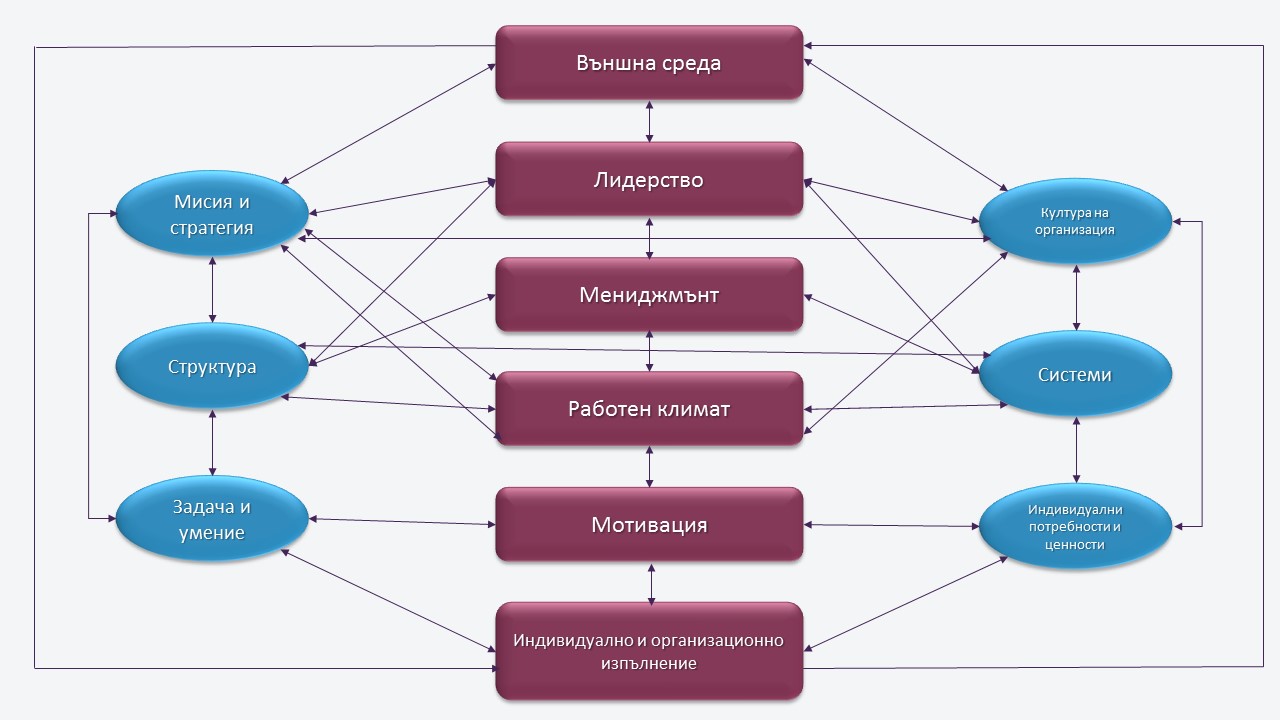
Here we will present a model for organizational change in a company. This model is named Burke-Litwin, after Warner Burke and George Litwin - consultants on organizational change who published on the topic in 1992. The model is based on their experience as consultants at British Airways during a change in ownership type.
The model aims to increase a company’s productivity by changing its ability to achieve greater goals in shorter periods of time, which in turn leads to increased profit. It also serves to diagnose the current organization and to plan organizational change. In principle, every organizational change brings some chaos into the company. To better control this chaos, the Burke-Litwin model describes key factors of organizational performance and effectiveness, indicating a number of two-way dependencies between them and their strength of impact.
What is the practical application of the model? The model presents the cause-and-effect relationships between transforming and transactional factors and their combination.
The model includes 12 factors relevant to every organization, with their combined action and causal links among themselves, which influence every change and can determine its outcome. These factors can be grouped into 4 groups, and each group has its own specific influence on change.
The four groups of factors are:
1) External environment - any influence originating outside the organization - a new competitor, the introduction of new technologies in business, a change in legislation or a change of government, a financial crisis, etc.
2) Transforming factors:
- Strategy and mission – the main goal of the company and how that goal can be achieved. The existence of a written mission adopted by employees is an important component of organizational effectiveness. Strategy is the way the company intends to achieve its main long-term goal.
- Leadership – the values, philosophy, and actions of the organization’s top management. Leadership effectiveness is measured through followers’ perceptions of leaders’ values and practices.
- Organizational, company culture - the values and norms of behavior adopted within the company. Company culture is also the sum of written and unwritten rules and principles, stable over time, that guide the organization’s actions.
3) Transactional factors:
- Structure - the company’s hierarchy, functions, employee roles, span and levels of management, communications, relationships, and decision-making rights for the purpose of implementing the company’s mission and strategy.
- Systems – rules, mechanisms, and procedures that facilitate work, as well as the daily actions employees in the company follow in order to do their work. Systems also include rewarding, evaluating an employee’s work performance, as well as achieving goals and budget and the allocation of human resources.
- Managerial practices - sets of actions for ensuring the company’s normal work environment, as well as the way human and material resources are managed and used, in order to effectively implement the company’s strategy and fulfill its mission and.
- Work climate or microclimate – the prevailing attitude and morale of employees in the company - the sum of current impressions, expectations, and feelings that members of a given department have, interpersonal relationships, relationships with the manager and with colleagues from other departments.
- Tasks, skills, and competencies of the individual – the degree of competence of employees in the company - knowledge, skills, and experience, so that they can meet the requirements of their positions in order to achieve better results.
- Individual needs and values – psychological factors that provide desire and meaning for physical or intellectual effort, the degree of employees’ desires and expectations in the company, that is, reward, work-life balance, their role and responsibilities in the organization, etc.
- Motivation – internal and external factors that inspire and stimulate people to work at a high level over the long term.
4) Individual organizational performance and company productivity – this is the final and real change in the organization and represents the individual or organizational performance after the changes carried out in the other factors, which, if the outcome is favorable, should lead to higher results and achievements.
Transformational factors are key to achieving the company’s goals. If the company wants to make a significant change, it must deal with them seriously - change something simultaneously in all three transformational factors to the extent needed for its goals. Transactional factors are also important, but in order for transactional factors to change, the transformational factors must be changed first. If there is no change in the key three transformational factors, change in the organization is often temporary and unstable.
Like all models, the Burke-Litwin model has its advantages and disadvantages. Let us examine them:
1) Advantages - the model presents cause-and-effect relationships, unlike the majority of purely descriptive models. The key factors identified and the dependencies between them have high practical value. The model has been developed and improved over the years, with professionals, consultants, and researchers participating in its development. In addition, the model was tested in practice for 5 years at British Airways, one of the most renowned airlines in the world.
2) Disadvantages - the model identifies only the external environment as the root cause of change. It does not consider internal environment factors as possible root causes, such as a change in top management, a change in the company strategy or mission, etc. The authors did not pay enough attention to mission and strategy, structure, and the relationship between an individual’s tasks and skills; they placed more emphasis on leadership, company culture, systems (especially reward), managerial practices, microclimate, motivation, individual needs and values, and performance.
Still, the Burke-Litwin Model for Organizational Change clarifies the key factors behind every change. It provides managers with a useful framework in which to orient their ideas and plans.
However, the model itself does not prescribe exactly how to implement change in the twelve factors.
You can learn more from our business training "Change Management". Learn more by ознакомizing yourself with its content and the way it is carried out. You can also ask us by contacting us at the following phone number +359 878 685 304 or by writing to us through the form below.

